
If you’ve been researching natural supplements for your dog’s anxiety, pain, or inflammation, you’ve probably come across CBD. And you may have quickly run into the complications — legal grey areas, regulatory uncertainty, mixed quality, and ongoing questions about whether it’s safe or appropriate for dogs.
There’s a better option that most UK dog owners haven’t heard of yet: beta-caryophyllene, or BCP.
What is beta-caryophyllene?
Beta-caryophyllene is a natural terpene — a plant compound found in black pepper, cloves, oregano, rosemary, and hops, among many other plants. It’s responsible for the spicy, peppery note in many herbs and spices. It’s been used in food as a flavouring agent for decades, and is classified as GRAS (Generally Recognised As Safe) by food safety authorities.
What makes it remarkable for dogs is what it does in the body.
How BCP works — and why it matters for dogs
BCP is the only known dietary terpene that directly activates the CB2 receptors of the endocannabinoid system. This is significant because CB2 receptors are distributed throughout the body — in immune tissue, the nervous system, and major organs — and play a central role in regulating inflammation, pain response, stress, and immunity.
Dogs have the same endocannabinoid system as humans. Their CB2 receptors respond to BCP in exactly the same way, making it a genuinely effective supplement for canine wellness — not a human product repurposed for pets.
Peer-reviewed research has shown that BCP demonstrates anti-inflammatory, analgesic, and anxiolytic (anti-anxiety) properties. Studies have found that BCP reduces inflammatory markers, suppresses pain signals, and — in anxiety models — produced calming effects even under conditions of significant stress.
Why BCP rather than CBD?
This is the question we hear most often, and the answer comes down to two things: regulatory clarity and receptor selectivity.
CBD in the UK sits in a complicated regulatory space for pets. It is classified as a novel food by the Food Standards Agency (FSA), which means products must go through an authorisation process — a process that most pet CBD products have not completed. The legality of giving CBD to dogs in the UK is, frankly, murky.
BCP has none of these complications. It’s a food-grade terpene regulated in the same way as essential oils and natural flavourings. There is no novel food issue, no FSA registration barrier, no grey area. It’s fully legal to sell, market, and give to your dog.
Beyond legality, BCP is also receptor-selective in a way that CBD is not. BCP targets CB2 receptors specifically, without affecting CB1 receptors — meaning none of the psychoactive risk associated with compounds that interact with the CB1 system. For dogs, whose nervous systems are more sensitive than humans, this specificity matters.
What can BCP do for your dog?
Based on current research and the experiences of thousands of dog owners using Cannanda’s CB2™ products:
-Reduces chronic inflammation, supporting dogs with arthritis or joint pain
-Calms anxiety, including separation anxiety and noise phobia (fireworks, thunder)
-Supports immune system function through CB2 receptor activation
-May improve mobility in older or less active dogs
-Supports recovery after exercise or injury
What product should I use?
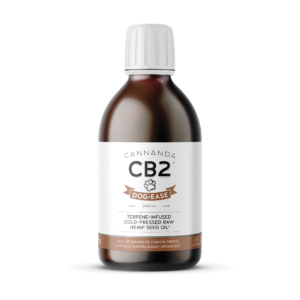
CB2™ Dog-Ease Hemp Seed Oil combines beta-caryophyllene with cold-pressed Canadian organic hemp seed oil — giving your dog both targeted CB2 receptor activation and the essential fatty acid nutrition that hemp seed oil provides. It’s the product recommended by Cannanda, the world’s leading BCP brand, and the only formulation of its kind available in the UK.
For higher-potency needs, the CB2™ Dog-Ease Blend (5ml) is a concentrated sublingual terpene blend that can be added directly to food or used topically.
Both products contain no CBD and no THC. They are completely legal in the UK with no restrictions on advertising, sale, or use.